
Hero Banner Image

International Partners

Building the Corridor

The Luzon Economic Corridor is a trilateral initiative launched in April 2024 by the Philippines, the United States, and Japan — the first Partnership for Global Infrastructure and Investment (PGI) economic corridor in the Indo-Pacific. In May 2026, eight additional nations joined as valued partners, contributing financing, technical assistance, and private-sector investment.

Founding Partners
Philippines
United States
Japan
Launched April 2024 First PGI Corridor in the Indo-Pacific

A Trilateral Initiative, A Growing Coalition

The Luzon Economic Corridor is a trilateral initiative launched in April 2024 by the Philippines, the United States, and Japan as the first Partnership for Global Infrastructure and Investment (PGI) economic corridor in the Indo-Pacific. It aims to enhance connectivity and economic activity across key nodes—Subic Bay, Clark, Manila, and Batangas—through coordinated investments in transport and logistics, energy systems, digital connectivity, and advanced manufacturing supply chains. The corridor, which accounts for roughly half of the Philippines’ GDP, seeks to create high-quality jobs, strengthen regional supply-chain resilience (including semiconductors and critical technologies), improve infrastructure quality under the principles of transparency, sustainability, and the rule of law, and position Luzon as a competitive economic hub.

In May 2026, the partnership expanded to include Australia, Canada, Denmark, France, Italy, the Republic of Korea, Sweden, and the United Kingdom as valued partners. These countries contribute through technical assistance, financing, facilitation of private-sector investment, and active participation in working groups focused on transport, energy, and digital infrastructure.

Founding Partners

The Philippines, the United States, and Japan launched the corridor in April 2024 and continue to anchor its development.

Founded April 2024
The Philippines—one of the three main partners alongside the United States and Japan—houses the Luzon Economic Corridor (LEC), which stretches across the central and northern parts of Luzon. The LEC encompasses key urban and industrial areas, including Metro Manila, CALABARZON, and Central Luzon. These areas make the LEC strategically significant as a hub for commerce, industry, and logistics, supporting economic growth and regional development.

Metro Manila is the epicenter of the Philippine economy, contributing approximately 36% of the country’s GDP. Batangas, part of the CALABARZON region, is a major industrial and manufacturing hub, contributing around 17% of national GDP. Central Luzon likewise contributes 9% of national GDP and plays a pivotal role in agriculture, logistics, and emerging industrial activities.

Given the economic importance of these areas, the Philippine government is prioritizing infrastructure development through the “Build Better More” program. The program aims to strengthen connectivity and support the region’s economic prospects through policies that improve the ease of doing business and attract foreign investment.
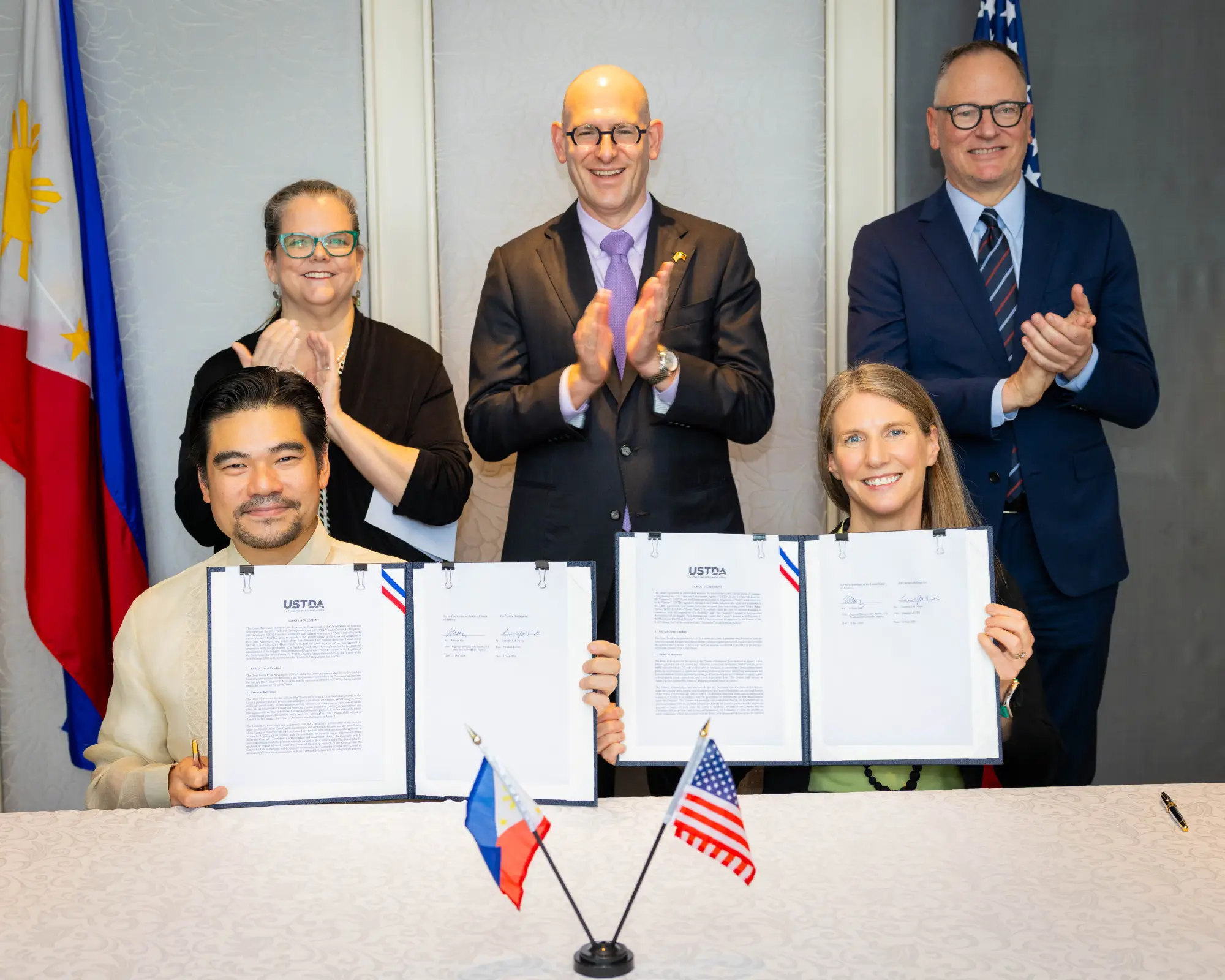
The United States, in coordination with the Philippines and Japan, is making significant contributions to the development of the Luzon Economic Corridor (LEC). Through the U.S. Trade and Development Agency (USTDA), grant funding for the pre-feasibility study of the Subic-Clark-Manila-Batangas (SCMB) Cargo Railway increased from USD 2.5 million (PHP 138.8 million) to USD 3.8 million. The study aims to improve logistics operations, reduce transport costs, and create jobs for thousands of Filipinos.

Alongside this effort, the U.S. is working with the Organization for Economic Cooperation and Development, in collaboration with Arizona State University, to conduct a comprehensive assessment of the Philippine semiconductor ecosystem. The initiative aims to strengthen the Philippine workforce and help the country double the number of its semiconductor facilities.

Beyond these initiatives, the U.S. government intends to use U.S. government tools to identify and address investment barriers in key sectors, including the Luzon corridor. This effort will draw on the PGI-IPEF Investment Accelerator’s model of creating investment corridors that bring together public and private capital.
Japan, one of the three main collaborators in the Luzon Economic Corridor (LEC), is supporting the development of key transport, trade, and digital infrastructure. A major initiative is the North-South Commuter Railway (Malolos-Tutuban), a modern passenger rail connecting Calamba to Clark International Airport via Manila. The project will improve workforce mobility, ease road congestion, and support economic activity across Metro Manila and Clark.

Japan is also funding a 30-year Railway Master Plan for the Greater Capital Region to guide the development of its railway network through 2055. It is further supporting railway capacity building through technical cooperation with the Philippine Railways Institute and the Metro Manila Development Authority on intelligent transportation systems.

On trade and investment, Japan and the Philippines have emphasized the full implementation of existing agreements, including the Philippines-Japan Economic Partnership Agreement, the ASEAN-Japan Comprehensive Economic Partnership, and the Regional Comprehensive Economic Partnership. Japan also supports the Philippines’ planned accession to the Comprehensive and Progressive Agreement for Trans-Pacific Partnership.

For digital connectivity, Japan is providing Official Development Assistance (ODA) to support high-quality, resilient, and sustainable infrastructure. This includes cooperation on digital infrastructure, such as undersea cables and 5G Open RAN technologies, as well as efforts to promote secure and trustworthy AI through the Japan-ASEAN Co-creation Initiative for AI.

Global Partners

Each partner nation brings distinct financing, expertise, and investment to the corridor's transport, energy, digital, and manufacturing priorities.

Australia

Australia supports the Luzon Economic Corridor through investment mobilization via its dedicated Manila Deal Team, technical assistance under its Partnerships for Infrastructure program, and a new AUD 45 million (PHP 1.9 billion) economic initiative known as PROGRESS, which promotes inclusive and sustainable regional growth. Through these efforts, Australia is helping strengthen connectivity and generate economic opportunities that benefit businesses, communities, and ordinary Filipinos.

Canada

Canada has provided an initial CAD 2 million (PHP 88.8 million) contribution for a technical-assistance project to be jointly identified by the governments of Canada and the Philippines. This support will advance infrastructure, supply-chain, and clean-energy projects while connecting Canadian firms to export and investment opportunities along the corridor. Canadian companies bring expertise in mining, critical materials, energy, artificial intelligence, and the digital economy—sectors that contribute to the Philippines’ long-term industrial transformation and economic resilience. Once in force, the Philippines–Canada Free Trade Agreement will further deepen economic cooperation.

Denmark

Denmark is contributing to the Luzon Economic Corridor by revitalizing Philippine shipbuilding, advancing green maritime innovation, and fostering investment, jobs, and sustainable industrial development. Working with both government and private-sector partners, Denmark’s shipbuilding initiative aims to create up to 10,000 jobs for the Filipino workforce.

France

France is strengthening connectivity and industrial capacity along the Luzon Economic Corridor through official development assistance and foreign direct investment. Its ODA supports the financing of 100 bridges, while investment in the aeronautics sector builds local industrial capabilities. Together these efforts contribute to modern transport, energy, and digital infrastructure across the Subic–Clark–Manila–Batangas corridor, reinforcing Luzon’s role as a dynamic and globally connected economic hub.

Italy

Italy is increasing its public financial support to facilitate private-sector investment by Italian companies in transport, semiconductors, and manufacturing. This assistance helps develop quality, resilient, and sustainable infrastructure while opening opportunities for Italian small- and medium-sized enterprises and mid-market firms in infrastructure engineering, energy technology, precision manufacturing, and logistics.

Republic of Korea

The Republic of Korea is advancing transport and digital connectivity and supporting sustained economic growth along the Luzon Economic Corridor through Official Development Assistance and public-private partnership initiatives. These include a USD 25.6 million (PHP 1.5 billion) grant to establish the National Cyber Security Center and participation in the Ninoy Aquino International Airport modernization PPP project.

Korea is also supporting high-value manufacturing, semiconductors, shipbuilding, and infrastructure. Notable investments include the expansion of Samsung Electro-Mechanics Philippines’ multilayer ceramic capacitor (MLCC) manufacturing facility in Laguna, which produces components for automobiles, smartphones, and other electronic devices, and HD Hyundai Heavy Industries’ shipbuilding operations in Subic, where the first locally built vessel is scheduled for completion in 2026. Korea is further engaged in the construction of the North-South Commuter Railway and the Subic-Clark-Manila-Batangas Railway—projects expected to significantly reduce travel times and transportation costs. These investments expand economic cooperation and create better jobs, improved connectivity, and more reliable services for Filipinos.

Sweden

Sweden is contributing USD 1.2 million (PHP 74 million) to the Subic-Clark-Manila-Batangas freight railway to fund a feasibility study on signaling systems and operational models. This partnership advances the shared vision of developing globally competitive logistics infrastructure that will attract investment and promote inclusive growth, while demonstrating strong synergies between public and private efforts.

United Kingdom

The United Kingdom is deploying its full Growth and Investment Partnerships (GIP+) toolkit in the Luzon Economic Corridor, providing technical assistance, up to USD 6.8 billion (PHP 419 billion) in export finance, and mobilizing capital for infrastructure and energy projects. UK Export Finance can support government projects directly, enabling high-quality, UK-backed infrastructure that advances the corridor’s ambitions and broader Philippine development goals. This commitment reflects strong investor confidence in the Philippines’ macroeconomic stability, reform momentum, and long-term prospects along the Corridor.
Skyline representing the Luzon Economic Corridor

Have A Sector In Mind?

Talk to our team about opportunities across energy, manufacturing, logistics, and more.